Art and Life in Novel Writing
 Classic and valuable archive. Misc pearls of utility, agent irritation points, plus takeaways on craft. Also, evil authors abound!

108 topics in this forum
-
- 1 follower
- 4 replies
- 4.9k views
How to prepare before sending queries to agents, e.g., utilize Publisher's Marketplace to intelligently narrow down the best possible candidates. Algonkian Writer Conferences reviews each step in turn. Here is our take on the smartest way to go about it. As a bonus, you learn a lot of insider knowledge about the business (like who is in "the club" and who is not--see below) along the way. You might also come to the realization that your ms is not yet ready. Such illumination is always a positive thing. Join Publisher's Marketplace and review it for at least a month (yes it costs a few bucks, but so what?). Search out the…
 Last reply by Kevin,
 -
- 1 reply
- 3.6k views
As you explore the nooks and literary crannies here, you'll find considerable words devoted to warning you away from foolish and terrible advice. But what about professional, tested, and proven advice? Below are ten bullet points for aspiring authors designed to help them overcome any confusion or misdirection when it comes to starting the novel. However, before you investigate, make certain you've already prepared by first reading this *very* sensible prologue. Note: the list below makes an assumption that the writer is a relative novice and currently searching for direction and focus--the same stage we've all endured. For those in the second stage, or hi…
 Last reply by EditorAdmin,
 -
- 3 replies
- 4k views
Below are partitioned criteria for engaging in critique of novel-length fiction. This will help guide your writer's group and make the critique more focused and less arbitrary. Premise and Plot Does the premise or story concept sound high concept? Original? If so, why? Defend your conclusion. What makes it unique when compared to published novels or nonfiction in the genre? You must effectively argue this case for or against. If against, present examples why it might not be sufficiently original to capture the interest of an agent or publisher. Are you able to discern the primary source of dramatic tension and complication that cr…
Last reply by EditorAdmin, -
- 1 follower
- 4 replies
- 826 views
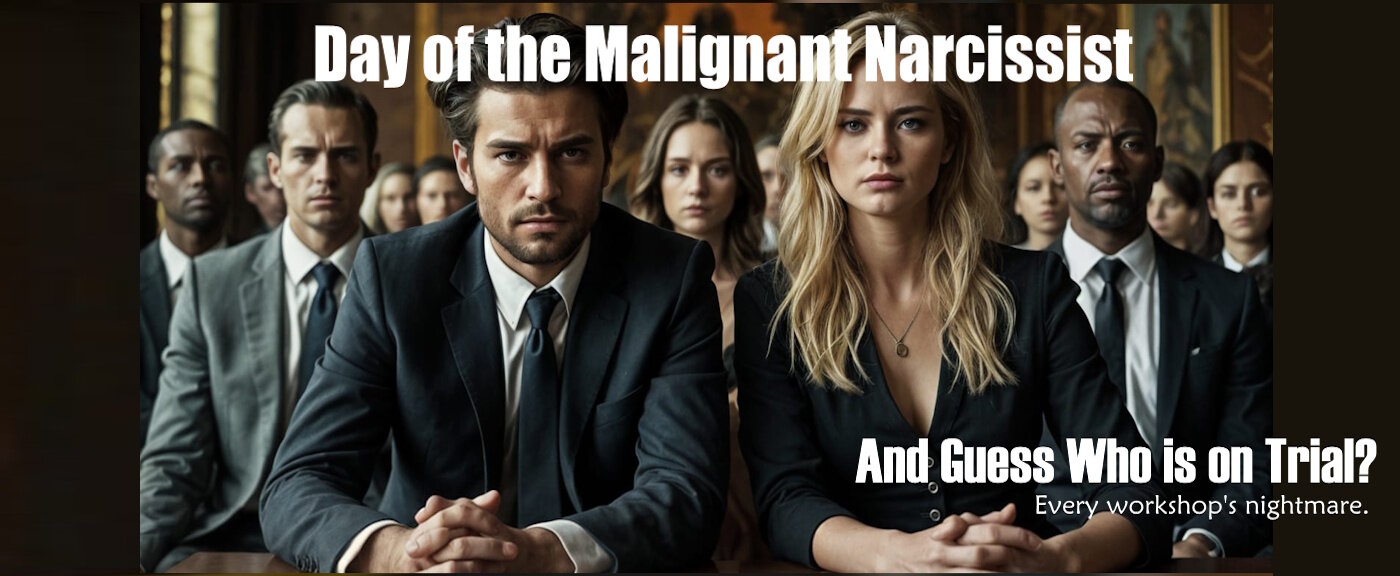
Over two and a half decades, Algonkian workshops and conference events have been subjected to at least a dozen very memorable and quite malignant narcissists, each one thin-skinned, childish, and predictably vindictive whenever confirmation of their greatness was not forthcoming. Below we meet one nightmarish example and then we proceed to examine alternative ways to defang their relentless ilk, techniques engineered to dilute their power enough to ensure future events will be less disrupted. And make no mistake, a determined and ego-wounded narcissist can wreck a workshop. Truly, they are the bane of writing teachers and workshop leaders alike. by Michael Nef…
 Last reply by Terrence Pershall,
 -
- 1 reply
- 3.2k views
Brilliant portrayal of the classic, ignorant narcissist who one day decides he'll soon write a bestseller despite the obvious fact he knows little or nothing about developing and writing a novel. ________________________________
Last reply by EditorAdmin, -
- 2 replies
- 2.2k views
Authorial Misdemeanors - Agent Richard Curtis There seems to be a law of nature that the quality of a manuscript declines in inverse proportion to the elaborateness of its package. When I receive a manuscript bound by brass screws with a plastic embossed cover, lovingly wrapped in chamois cloth, set in a velvet-lined cedar box, shrink-wrapped, packed in turn in a fireproof strongbox secured with iron bands, I am prepared to stake my career on the likelihood that this book is one colossal dud. From time to time an author will do something that causes me to scratch my head. I've compiled a list of these foibles and offer it here with a…
Last reply by EditorAdmin, -
- 3 replies
- 996 views
So your agent has finally found a sympathetic editor for your wondrously impatient manuscript? And they work at a major publishing house, imprint, or press. Now you think you're in tight? Whooo! Think again. The obstacle course has just begun. Your credentials and manuscript are facing the gauntlet of THE PUB BOARD! The what? A group of chair-bound editors and professional types at the press who down or up their thumbs for the stack of proposals sitting in front of them; and it varies from place to place, but more often than not, the pub board meets once a month. They include the specific editor who is a fan of your manuscript, of co…
Last reply by Chief Editor M. Neff, -
- 3 replies
- 3.2k views
From the Desk of Agent Richard Curtis ***** (Best of Writer's Edge) "The truth is that if all other things are equal, the author with better writing skills is the one who will rise out of the pack." As the stakes continue to rise in the publishing business, writers are adopting a wide range of strategies to advance themselves out of the midlist and onto better-selling plateaus. I myself have recommended a number of such strategies. Recently, however, as I respond again and again to the question of what one can do to escape midlist oblivion, it's begun to dawn on me that many writers have been ignoring the most obvious …
 Last reply by David Wollover,
 -
- 2 replies
- 2k views
by Michael Neff At a conservative estimate, upwards of 250,000 writers in the U.S. are currently struggling to write or find an agent for their first commercial novel or memoir. If you understand this business, you also know why an enormous percentage are unable to make it happen. Below are the top seven reasons why otherwise passionate writers will join the 99.9% never to become commercially published. 1. INADEQUATE WRITING SKILLS AND STORYTELLING PROBLEMS In the case of the former, the writing itself does not display the energy, creativity, and polish necessary to convince an agent to go deeper. This is perhaps the number one cause of failure. Usually, t…
 Last reply by Artemis,
 -
- 0 replies
- 1k views
By Chris Stewart As someone who organizes readings and a large literary arts festival with workshops, author appearances, and exhibitors, over the last ten years I have developed a list of writers who I will not work with again. And rest assured, I’m not the only one who does this. Why? Because they didn’t follow directions. It’s that simple. Who's on it? Writers who acted like the organizer/staff were their personal assistant/manager. Take note of the following ways to avoid this blacklist and be a true professional! KNOW YOUR OWN SCHEDULE Double booking is such a big no-no we can’t believe you’re not aware of this already yourself. Whatev…
Last reply by Chief Editor M. Neff, -

- 0 replies
- 933 views
Writing the Breakout Novel 1. It helped me step back and evaluate my novel more objectively. There are specifics that need to be there intentionally, not just accidentally, including a strong theme that is understated through the characters rather than preached through narration. 2. I learned that the romance subplot needs to be more developed. Presently, there is nothing at stake, and it is little more than an afterthought. My book also needs improvement in description on all levels, especially in describing setting without excessive use of adjectives and adverbs or using teacup handicaps. 3. The one complication between the book and the novel writing program is th…
Last reply by KeriLadner, -

- 0 replies
- 1k views
The art of fiction This book does a great job of inspiring the creative spark with its built in lessons, and its a perfect starting place for new writers for this reason. John Gardner's respect for writing as an art form is appreciated, because he stresses the importance of writing not being clearly defined by "do's" and "do not's", or complex mathematical equations. I like the reminder that every subtle detail must be relevant in the story, and that unimportant facts need to become so or simply discarded. This is an easy mistake to make, and the book helps to teach how destructive it can be. It is certainly something I keep a keen eye out for in my revisions. The…
Last reply by AndrewCratsley, -
"The Art of Fiction" by John Gardner Since honesty is what you’re seeking... At the time I read it, I remember feeling very annoyed with Gardner and got very little out of the first part of the book. However, now, as I flip through my copy, I’m struck by how much I highlighted and certain passages are connecting. “In all the major genres, vivid detail is the life blood of fiction.â€� And the writer “must create, stroke by stroke, powerfully convincing characters and settings; he must more and more clearly define for himself what his overall theme or idea is; and he must choose and aesthetically justify his genre and style.â€� I had to remind myself to remain i…
 Last reply by AnnaN999,
 -
-
.thumb.jpg.fab15a14084b2920f0e0aea5a9994cde.jpg)
- 1 reply
- 5k views
I suspect that most writers have “Get Published” on their list of goals for the year. Given that this assumption is correct (and I’m pretty sure it is), I’m dedicating this week’s post and next week’s to getting published and what to expect in the process. Whether you’re looking into the traditional route or self-publishing, I’ve got something for everyone. Without further ado, here are my top five picks for this week: #1: Podcast 365. Sunrise, Sunset, and Behind the Scenes in Publishing: Hanging out with Abby Zidle Abby Zidle is the senior editor and associate director of marketing at Gallery Books. While this podcast is mostly geared toward the romance genre, …
 Last reply by Kathy LaFollett,
 -
- 1 reply
- 3.6k views
It’s here! The much anticipated second part to getting published. These articles will round out the information you already got in Part 1, but also give you more to consider when picking your publishing path. Ready or not, here are my top picks for the week: #1: How to Secure a Traditional Book Deal By Self-Publishing Jane Freidman brings up a lot of really good points about why, or why not, a writer should ever consider doing this. I warn you, going this route is not for the faint of heart. I’ll let Jane explain why. #2: Friday Speak Out!: No More Query Letters Why one woman decided—only after many years of writing—that the traditional publishing care…
 Last reply by elisehartkipness,
 -
- 0 replies
- 1.3k views
A WATERSHED EVENT FOR SERIOUS WRITERS Whatever the stage of your project or writing life, know that all writers, if they desire to become commercially published, must see and enter the Epiphany Light. First of all, what is the "Epiphany Light"? The EL is a state of mind crucial to any aspiring author desirous of commercial or serious literary publication, and one which clearly divides the 99% from the 1% of those who've learned the hard way how challenging it is to have their expertise and projects taken seriously by professionals in the publishing business. But are the percentages so drastic as depicted here? Yes, and probably even more so. Consider …
Last reply by Chief Editor M. Neff, -

- 0 replies
- 1.2k views
Writing the Breakout Novel: 1. Writing the Breakout Novel was my favorite craft book of this series. This book taught me a lot about what makes specific novels fall into the “breakoutâ€� category, such as how to create a good conflict, how to make theme memorable and relatable, and how to create larger-than-life characters. Overall, Maass gave very specific examples to allow me to not only learn but also see what makes breakout fiction and how to re-create those techniques in my own writing. It also helped me as a writer because it planted all these seeds about what I should be thinking about while I’m working, which was very helpful. 2. I think the biggest less…
Last reply by A. A. Woods, -
- 0 replies
- 1.8k views
Barbara Zitwer specializes in discovering new writers from all over the world. They look for writers with original voices and who have commercial, international appeal, and also for books that have potential to be developed for film and television. Barbara Zitwer herself specializes in developing books and editing. She has written several books as well as the play, PAPER DOLL, about Jaqueline Susann, produced in regional theaters throughout the US. She has produced landmark films such as VAMPIRE'S KISS with Nicolas Cage, was Executive Producer on LAZARUS RISING with Columbia Tri-Star and Bernie Sofronski, and she executive produced THE FRIDAY NIGHT KNITTING CLUB with Juli…
Last reply by Chief Editor M. Neff, -

- 0 replies
- 980 views
AS II – Module 8 Book Reports "The Art of Fiction" by John Gardner (a great primer for this commercial program) 1. How did the book help you as a writer? What overall aspects of it taught you something? This is the second time I’ve read this book. It should be the first book any writer reads on the craft of writing. It validated the areas of craft that I’ve been studying for the past eight-plus years. The book taught me that you have to know the rules of craft and master them before you can break them or create your own. 2. What two or three major lessons did you learn from the book that you can apply to your writing and/or your novel? a. The…
Last reply by BillDoughertywrites, -

- 0 replies
- 995 views
THE ART OF FICTION, John Gardner How the book helped me as a writer: The copy I have is dated 1984, and it was interesting to see what I’d underlined in red, what my younger writer self found important. There were many great insights and to be reminded of things like not starting a sentence with an infinite verb phrase, were valuable. Gardner wrote, “The reader cannot understand or believe the change unless some clue is provided as to the reason for it.â€� And “moment by moment authenticating detail as the mainstay of fiction.â€� I find myself struggling as I revise, finding so many instances where I have not provided enough of a reason for one of my cha…
Last reply by MaiaCaron, -

- 0 replies
- 941 views
BOOK REPORTS: 1. How did the book help you as a writer? What overall aspects of it taught you something? 2. What two or three major lessons did you learn from the book that you can apply to your writing and/or your novel? 3. Was there anything in the books that obviously conflicted with lessons and readings in our novel writing program. If so, what were they? THE ART OF FICTION, John Gardner
Last reply by LauraCastro, -

- 0 replies
- 1k views
“The Art of Fictionâ€�, John Gardner How did the book help you as a writer? What overall aspects of it taught you something? This book gave me courage to break rules in my writing. Knowing the rules is imperative before breaking them. But I realize that many of my favorite books have rule-breaking elements in them. I detected an overall theme of aggressive attack in writing - through plot, dialogue, setting, characters, concrete details. Since I write YA, much of my writing is first-person present. Gardner is not a fan! But he did have some great tips on carrying the narrative and not starting every sentence with “I.â€� The big lesson for me: Balance is everyt…
Last reply by LauraNamey, -

- 0 replies
- 952 views
Books on Technique Utilized in The Novel Writing Program â—¾"The Art of Fiction" by John Gardner (a great primer for this commercial program) â—¾"Writing the Breakout Novel" by Donald Maass (another good primer) â—¾"Write Away" by Elizabeth George (a no nonsense primer, and humorous) â—¾"The Writing Life" by Annie Dillard (a look at the struggle) ________________________________________________________________________________ As you've noted on the novel writing program website, the above books are listed as must reads for this program. And that can't be closer to the truth. Therefore, the purpose of this forum is to cajole you into taking what you'…
Last reply by LutherLovelace, -

- 0 replies
- 991 views
Book Reports: Gardner The Art of Fiction taught me that there are no absolute rules when it comes to fiction. For example, a term used often with regard to creative writing instruction is “show don’t tellâ€�. For many beginning writers this is good advice especially if they are drowning in abstraction. However, for the art of fiction to be entirely void of exposition is disastrous, turning a novel into a screenplay. While these rules can be helpful tools, the writer has to assess them and use them fittingly. One vital lesson from this book is “What Fancy sends, the writer must order by Judgementâ€�. An author may discover a tantalizing plot point but if it is not …
Last reply by Stephanie Hansen, -

- 0 replies
- 988 views
The Art of Fiction: I had the good fortune of drinking in some of the same bars Gardner frequented. I was an undergrad at SIU-Carbondale. Didn't know him. Or maybe I did. I drank a lot in those days, then went back to the dorm and had ponderous discussions about the meaning of everything. Maybe this is where this book came originated. I might have been there. I don't remember, but it makes a good story, particularly if one forgets that Gardner was a family man with young children and a national reputation following the publication of Grendel. Did I know him? Probably not. Did I sit in the dorm lounge, drinking crappy beer and pontificating about the virtues of clean writ…
Last reply by ChristineRoberts,



ALGONKIAN SUCCESS STORIES
What should you accept as credible?
Where it All Began