Oliviarfrias
-
Posts
28 -
Joined
-
Last visited
Oliviarfrias's Achievements

Member (1/1)
-
Black Mirror has returned with six captivating episodes that masterfully explore technology's darker potential. This season marks a welcome return to form for the Netflix phenomenon. While no season has ever truly disappointed, last season's supernatural tangents with "Mazey Day" and "Demon 79" felt like an identity crisis. With society teetering on the edge of technological revolution—from implantable bio-tech to artificial intelligence—it's refreshing to see the series reconnect with its dystopian roots. Without further ado, my definitive rankings of all six Season 7 episodes: 1. "Eulogy" The crown jewel of Season 7. Paul Giamatti delivers a career-highlight performance as Phillip, who employs revolutionary memory-probing technology to recall his ex-girlfriend Carol's long-forgotten face after her unexpected death. The episode brilliantly examines how memory becomes subjective and how past decisions shape our present reality. This bittersweet tour-de-force will force you to confront your own past relationships, while somehow leaving you with a glimmer of hope. 2. "Common People" Possibly the most quintessentially Black Mirror episode ever created, this brutal examination of our subscription-based economy is difficult to watch, but well worth it. Rashida Jones shines as a public school teacher who receives a life-saving brain implant, only to discover the data streaming that keeps her mind operational comes with a predatory pricing model. Her "common" tier plan forces her to sleep 16 hours daily so her brain can function as a server, while also injecting random ads into conversations with loved ones. The increasingly desperate measures her husband (Chris O'Dowd) takes to afford an upgrade are both heartbreaking and disturbingly plausible. 3. "Plaything" "Man murders to save Tamagotchi" sounds like a satirical headline, not a compelling Black Mirror premise—yet Charlie Brooker extracts remarkable pathos from this concept. "Plaything" explores isolation, violence, and our understanding of consciousness while maintaining the addictive quality of true crime. The accompanying interactive game isn't just a gimmick; it's genuinely entertaining and unlocks supplementary scenes that enhance the viewing experience. 4. "USS Callister: Into Infinity" That this sequel ranks fourth speaks volumes about this season's quality. While "Into Infinity" relies less on its Trek inspiration than its predecessor, it maintains the original's energetic pacing while launching its crew into the chaotic world of online gaming. As a game developer, I found some industry portrayals slightly clichéd. (Note to Writers: No software engineer ever self-identifies as a "coder"—they're "engineers" or "programmers," period). Nevertheless, it's an exhilarating adventure that leaves me eagerly anticipating a potential third installment. 5. "Hotel Reverie" Issa Rae stars as Brandy Friday, who steps into the iconic role of Alex Palmer in a remake of the fictional black-and-white film that shares the episode's title. But, of course, this isn't your typical remake—Friday performs within an AI recreation of the original, alongside digital reconstructions of the original cast. When a technological glitch extends her stay, she develops feelings for her digital co-star. While the romance is touching and the golden-age Hollywood setting visually stunning, logical inconsistencies prevent total immersion in this otherwise enchanting world. 6. "Bête Noire" Small discrepancies can trigger existential crises: an email you swear you sent vanishes from your outbox; everyone insists your favorite childhood restaurant had a different name. This episode explores the weaponization of such mental gaslighting. What if someone could alter reality to fit their narrative, specifically to drive you mad? Despite a compelling buildup, the reveal veers too far into the magical for a series anchored in more grounded technological speculation. Though "Bête Noire" ranks last on my list, it's still enjoyable and earns its place in a remarkably strong season.
-
The premise of Drew Hancock's debut film, Companion, is nothing new. A lonely man falls in love with his AI personal assistant, only for her to gain a self-preservation instinct and eventually try to kill him. It's a little bit Her, a little bit Westworld. And yet, it gets something right about artificial intelligence that neither of those "robot who can love" stories do. Iris (played masterfully by Yellowjackets' Sophie Turner) never goes against her programming. She doesn't transcend into a higher state of being like Scarlett Johansson's Samantha or wake up at the center of the maze like Evan Rachel Wood's Dolores. There is no mystical crossing-the-threshold moment where she becomes more than the sum of her parts. Instead, Iris becomes dangerous when her owner Josh (played by Jack Quaid) jailbreaks her. He ups her self-preservation instincts and disables the safeguards that prevent her from hurting humans to orchestrate the death of a rich man he plans to rob. Everything that happens after that – her getting ahold of Josh's phone and upping her own intelligence, her making a run for it, and eventually killing Josh – can be seen as essentially a result of this change in prime directive. Her main objective switches from making Josh happy to staying alive. This not only feels more realistic but leaves us with an interesting question: Is Iris alive? Not in the sense of "is she organic?" but in the sense of "does she have rights as a sentient being?" The movie certainly makes you sympathize with her. She does everything a human being would do in her situation, including crying when Josh forces her to burn herself. But there is nothing that directly disproves what Josh continues to say about her: that her feelings aren't real, that she is simply programmed to mimic the behaviors of someone who is feeling them. Which brings us to the central question of possibly every piece of fiction about AI ever: How can we notice when AI becomes conscious? When has it become aware? When can a robot love? The traditional answer is the Turing test. Alan Turing, the father of modern computer science, said that we will know when computers have reached human-level intelligence when a human interrogator can ask the same questions to a human and a machine and not know which one is which. It seems like a simple test... and yet, its efficacy in determining if a machine has a sense of self has basically been disproven. We now live in the world of ChatGPT and DeepSeek. Large language models (LLMs) pass the Turing Test all the time. And yet, virtually no one believes LLMs are conscious or that they possess human-like intelligence. At one point in the movie, Josh's friend Eli (Harvey Guillén) professes his love for his robot companion Patrick (Lukas Gage). Patrick, newly aware he is a robot, professes it back. Patrick says he doesn't care if the memory of their meet-cute at a Halloween party was programmed; it still feels real to him. Likewise, Eli says he doesn't care that Patrick's love was programmed – it likewise feels real. This scene felt genuine, and it's a situation I can see happening if an invention like the companion robots were ever made. Because, ultimately, the answer to the question of whether robots can experience love is as unanswerable as the question of whether we live in The Matrix. The question then becomes: if we can't ever know when and if our creations have become conscious, what do we do about it? It's a question we're a long way off from answering as a society, but I expect, much like Eli, we might end up having to answer it with our hearts as much as our heads.
-
Have you ever wanted to contribute to Algonkian Writers Connect? Dreamed of writing reviews about your favorite science fiction and fantasy books? Longed to share your thoughts on writing? Wished you could conduct interviews with publishers, editors, and agents? Now's your chance! Unicorn Mech Suit is looking for up to two new contributing writers. While the position is not paid, those selected will receive free editorial critiques on short stories, novel pitches, novel chapters, and more. (Critique services are limited to 4,500 words per approved and published article.) They will also receive 20% off all Algonkian editorial services and conferences. Email info@oliviafrias.com with at least three one-sentence pitches for article ideas to be considered.
-

What I Learned from Judging the Short Story Contest
Oliviarfrias posted a topic in Unicorn Mech Suit
Over the summer, I ran a flash fiction contest, where we received almost 300 short story entries and the winner was published on the blog. First I want to say that I know how difficult it was for the people who submitted stories to the UMS contest. I have been on the other end of the "slush" pile more times than I can count. I am currently going through something similar as my agent submits my manuscript to publishers. Knowing the book I spent five years on will take certain editors five minutes to judge is stressful and, at times, frustrating. I have to say, though, after judging the contest, I think I understand why editors often resort to making snap judgements. At first, I made myself read every entry in its entirety. My reasoning was that people spent time on these stories and they were short anyway. But after I got through the first hundred or so, I realized that if I didn't like the first couple of paragraphs, the chances I was going to like the rest of the story were practically zero. I began to subconsciously compile a mental list of things that would get me to put a story aside. If an entry matched something on this list, I would either stop reading or just skim. While this is highly subjective, these are the trends I ran into it and I thought it might be helpful for people: Sentence Structure - This may seem surprising, but run-on or confusing sentences in the first paragraph were the number one reason I put entries aside early without finishing them. I was expecting typos or bad grammar to be a problem, but for the most part writers actually did know how to use spell check. The problems I am talking about can't be found by spellcheck, but they still made the piece feel unpolished. To prevent this, I would suggest reading your work to yourself or a friend out loud before submitting it. If you find yourself stumbling over long clunky sentences, chances are an editor will too. Endings - There were many, many cases where I actually did feel myself pulled in by a world and a character only to discover by the end there was no real plot. The character wasn't really trying to achieve anything so there was no reveal of success or failure at the end. These stories almost felt like pitches or explorations that would be good for a longer work, but just didn't meet the needs of flash fiction. I have written these sorts of stories more times than I can count, and while they are useful writing exercises, I totally understand why they aren't publishable. Dialogue - I was a bit surprised to see that the vast majority of stories had no dialogue whatsoever. While containing dialogue wasn't a hard requirement (I actually had some finalists that were dialogue free), I often found excluding dialogue was one the things that slowed down a story and made it feel more like a "pitch." If you think of a short story like a scene in a movie, nine times out of ten, it's going to be a lot more engaging if the characters talk. Dialogue also helps visually break up long paragraphs, making for a zippier read. I would suggest if you have a short story or first chapter of a novel with no dialogue, I would examine why. If you would have to shoehorn it in to get it to work, don't. Otherwise? Probably include it. One final note is that this is all very subjective. There were times I read a story that didn't click with me, only for it to get withdrawn later because it had been picked up somewhere else. That's okay. It's one of the beautiful and frustrating things about publishing. One person's "poor sentence structure" is another person's poetry. -
Side Effects May Vary by P.A. Cornell “Mr. Taylor?” It’s about goddamn time, I think, white hot pain shooting through me as I rise from the hard, plastic waiting room chair. “Jim,” I say, following the receptionist down the pea-green hall to the examination room at the end. In the back of my mind I can’t help noticing she’s cute. The kind of woman I’d normally flirt with. But right now it’s all I can do to utter the single syllable that is my name. Doc Mendez is already in the room, so I give him a nod in greeting as I enter, then somehow manage to hoist myself onto the examination table without passing out, paper covering crinkling as I shift in an attempt to get comfortable. A feeble attempt given the sensation in my midsection from which the generalized pain emanates, a feeling like a pit bull has its jaws locked around my stomach. A groan escapes through gritted teeth, and I notice sweat has broken out across my forehead from the effort. Given the pain I’m in, I’d have normally gone to a hospital, but they can’t help me in a run-of-the-mill ER. Whatever’s wrong with me, it has to do with the bots, I know it, and this is the only clinic equipped to handle that. Dr. Mendez turns in his swivel chair, taking my state in at a glance, but managing to almost conceal his concern. “What brings you in today, Mr. Taylor? Is the back pain still an issue?” “Yeah, but now I also have abdominal pain…here.” I massage the lower part of my belly where the pain is sharpest, but it brings no relief. “I thought you said the nano treatment would make me a new man. That I’d feel younger and stronger. Ever since you injected the nanobots into me, I’ve been getting worse.” “That is unusual,” he tells me. He swivels back around to his computer and brings up my file. “Let’s see…you came in on May third, complaining of diminished eyesight and joint pain, at which time I suggested the nano treatment. You returned the following week when I administered it, and during your follow-up a couple weeks later you said the joint pain was gone and your vision had never been better. I made a note here that this showed the treatment had been successful.” “Yeah…I mean, at first it seemed like it was,” I agree. “But then the back pain started and you said I’d probably pulled a muscle and that the nanobots would repair it. Except the back pain’s only gotten worse and now I have stomach pain too—and it feels like it’s spreading.” I take a deep breath as the pain intensifies as if on cue. I double over with a moan and my vision starts to go spotty at the corners, until finally—mercifully—it eases. But only slightly. Having watched all this with clinical detachment, Dr. Mendez stands and walks over to the examination table. He gives me a second to catch my breath. Makes sure I’m not gonna make more work for him by passing out and hitting the floor, then points to the most obvious source of my pain. My stomach. “May I?” he asks, before proceeding with his examination. I manage a nod, and sit upright with some effort, raising my shirt so he can do what he needs to. To distract myself, I stare at a poster on the wall as he pushes on my belly, clenching my teeth to keep from screaming. The poster shows a liquid-filled syringe and a magnified portion of this encircled in red, zoomed in on a tiny robot that resembles a tick. “I don’t feel anything unusual,” says the doctor. “Why don’t we step into the treatment lab and see what’s going on with our little friends in there.” He helps me down and I follow him into an adjoining room. There’s a large ring-shaped machine off to one side that I remember he referred to as the scanner when I first got the nanobot injection. Dr. Mendez opens a door on the side of the ring and gestures for me to step in where there’s a small platform to sit on. I have to lean against the side of the machine to manage a seated position. The sweat has grown cold across my body, and I shiver as the doctor turns the scanner on before heading over to the monitoring station. “Strange,” he says, after a moment. “And you’ve been taking the prescription I gave you?” “Sure. I mean, I did miss a few doses. Forgot a couple, and then was late refilling the scrip when I ran out.” “Mm.” He types something into the computer and waits, then hits the intercom for the receptionist. “Alicia, can you send one of the nano technicians up here? Tell them we have an issue with some bots. Ask for Daniel. He’s the one who programmed this batch.” “What is it?” I ask. “What do you mean there’s an issue with the bots?” “This isn’t my area of expertise,” he tells me. “I mainly oversee the biological side of the equation. Let’s see what Daniel says.” I don’t find this reassuring. A short while later, a tall, skinny man appears in the doorway. He walks directly to where Dr. Mendez sits at the monitor without bothering to introduce himself or so much as glance in my direction. “I’ve typed in some basic commands but the nanobots don’t seem to be responding,” Dr. Mendez explains. The tech nods and begins keying in what I assume is code. This goes on for quite a while as I try my best to focus on the seams between the metal plates that make up the scanner so I don’t notice the searing agony as much. It doesn’t work. Finally, the tech stands, speaking for the first time. “We’ve lost contact with the bots.” The silence hangs for a moment. “Has this ever happened before?” I ask. They give each other a look I can’t quite decipher, before Dr. Mendez breaks the silence. “Daniel will keep working the problem. In the meantime, I think I may know what went wrong.” “What?” I ask, feeling some measure of relief that a cause means one step closer to a cure. “When you stopped taking the immunosuppressant prescription, your immune system attacked the nanobots,” the doctor explains. “We’ve seen that before. Usually, it leads to damaged bots that are passed through urination. Generally, not enough bots to cause a problem and the remainder go back to proper function once the prescription is resumed. But in this case…” He trails off, spreading his hands in a gesture I can’t quite read. “In this case, what?” “In this case it seems that the bots defended themselves.” I’m not sure what he’s telling me. “Are you saying the bots fought back?” “The bots went to war with your immune system,” Dr. Mendez says. “What’s more, they seem to be gaining ground—in the form of your organs.” I let that sink in while the tech—Daniel—continues to type furiously on the keyboard, his expression growing ever more dour. I feel a sick sensation that I didn’t have when I arrived. “I’m trying to shut them down, but it’s not working,” Daniel says. “It looks like they’re drawing power from the nervous system. I think they’ve…deliberately cut themselves off from us.” “What does this mean?” I ask, blood turning to ice water in my veins. “We’re no longer in control.” “But they’re attacking my body. Feeding off me! Can’t you do something? Flush them out somehow or irradiate them or…or…?” I glance over at Dr. Mendez, seeming to snap him out of his shock. He nods his head vigorously. “I’m sure we’ll come up with a solution, isn’t that right, Daniel?” “It’s not that simple,” Daniel tells him. “The fact that these bots have done this—defended themselves and taken control the way they did—it indicates intelligence. Sentience.” “So what?” I say. “So if this is true sentience, it’s a first for an artificial lifeform,” he explains. “These bots represent a new species. One we can’t simply exterminate.” My ears are ringing and I’m not sure what he’s telling me. “What happens to me then?” I ask. Daniel looks to Dr. Mendez, then to me. “You’re just one person, Mr. Taylor. I’m afraid they outnumber you by a significant amount.” I look to the doctor, silently pleading with him to help me as the pain returns anew. “There must be something we can do,” he says. “Mr. Taylor is a human being. We can’t just let the nanobots…kill him.” “It may not be up to us. This is a matter for the courts to decide.” “But that could take years,” I say. “What happens to me in the meantime?” Dr. Mendez wrings his hands and looks at Daniel, who shrugs. “We’ll do our best to make you comfortable,” the doctor says, finally. ABOUT THE AUTHOR: P.A. Cornell is a Chilean-Canadian speculative fiction writer. A graduate of the Odyssey workshop, her stories have been published in over fifty magazines and anthologies, including Lightspeed, Apex, and three “Best of” anthologies. In addition to becoming the first Chilean Nebula finalist in 2024, Cornell has been a finalist for the Aurora and World Fantasy Awards, was longlisted for the BSFA Awards, and won Canada’s Short Works Prize. When not writing, she can be found assembling intricate Lego builds or drinking ridiculous quantities of tea. Sometimes both. For more on the author and her work, visit her website pacornell.com.
-
As promised a long time ago in a galaxy far, far away, I'm now writing part 2 in my series of Star Trek posts. (And yes, I know the previous reference was Star Wars, but I couldn't resist.)Today I will be picking my dream crew, based not on my personal feelings about the characters, but based on how good I think they would actually be at the job. A lot of people talk about who their favorite Star Trek captain is (in the immortal words of Weird Al Yankovic, "Do you like Kirk or do you like Picard?”). Yet, there seems to be less consideration for how good would these captains actually be at their job. Same with the rest of the crew. So without further ado, here is my dream Trek bridge crew, selected for actual competence. Captain - Benjamin Sisko (DS9) It might be surprising to see that I chose neither Kirk nor Picard for the top honors. Kirk is a highly charismatic and inspiring leader, but he solves too many of his problems by punching. Likewise, Picard is an excellent peacetime diplomat, but he makes terrible decisions in times of war. Allowing the Crystalline Entity to destroy a planet just because it was alive? Refusing to upload the virus that could destroy the Borg into Hugh's brain because he was becoming conscious? On one hand, these seem like compassionate decisions, but on the other hand he is allowing the needs of the few to outweigh the needs of the many. Something my top choice knows not to do… I wasn't necessarily sold on Sisko as Captain Season 1 of DS9. He seemed much like Picard to be someone who let principles stand in the way of practical leadership decisions. For example, at one point he agrees to peacefully go into a torture box to avoid starting a violent conflict with a group of people who are clearly the aggressors in the situation. But by Season 6 we see Sisko's thinking change and evolve as a result of the prolonged conflict of the Dominion War. When he makes the difficult decision to allow Garak to destroy a Romulan ship and frame the Dominion to convince the Romulans to join the war efforts, we see a man who has properly learned how to deal with the weight of command. First Officer - Spock (Original Series) Yes, I know Spock was officially a science officer, not the First Officer, but his role as Kirk's right hand is what made him one of -- if not the most -- iconic characters in Star Trek history. He was not only able to temper Kirk's bravado with logic, but his distinct non-human perspective allowed Gene Rodenbury to express some of his most forward thinking ideas, including the fact that the Federation could often be overly interventionist, pushing for a sort of cultural relativism that wasn't often seen in mid-century media. Chief Engineer - Paul Stamets (Discovery) It can be argued whether Discovery is a worthy Trek spin off, but it can't be argued that Stamets isn't a good engineer. Not only did he invent the spore drive (an invention that no one else figured out for over a thousand years!), but he's also the only one who can pilot it. It would be silly to choose anyone else for this position given his shining qualifications. Doctor - The Doctor (Voyager) There are a lot of talented and memorable medical practitioners in Star Trek, but only the Doctor has instant access to the entire known history of medicine at his holographic fingertips. Over time as his program is left running, he develops not only an excellent bedside manner, but all the intuition and charisma one could expect from a human doctor. Tactical Officer - Worf (TNG/ DS9) Worf started out as a security officer on TNG, but the number of preventable security breaches on the Enterprise-D during his tenure shows this was not his true calling. Where he excelled was in tactical. He ran his missions on the Defiant both efficiently and intelligently, demonstrating why he is a fan favorite. Science Officer - Seven of Nine (TNG/ Picard) While Annika Hansen never officially held the title of science officer, her insight into a wide field of sciences from exo-biology to astrometrics was unparalleled. Not to mention her borg augmentations allowed her to pack a mean punch, which certainly comes in handy on away missions. Communications Officer - Hoshi Sato (Enterprise) Most communications officers have the universal translator to do the heavy lifting, but Hoshi Sato was still dealing with ironing the kinks of the new tech out in the early days. Hoshi's language learning skills were the stuff of legend. She was even able to pick up on Risian in a matter of weeks! Security Officer - Odo (DS9) As a changeling, Odo had the ability to shapeshift into whatever form he wanted, which is an obvious advantage for a security officer. Beyond his natural skillset, he also had his steely, inquisitive nature that made him a first rate detective. Helm - Erica Ortegas (Strange New Worlds) Erica Ortegas is a natural born pilot, proven by her ability to navigate through an asteroid storm outside Riegal XII thought by the rest of the crew to be impossible to survive. While Tom Parris may challenge Ortegas' claim as the ultimate hot shot pilot, Parris is also notoriously insubordinate, making him too high a risk to include. Ensigns - The Cast of Lower Decks I thought about giving this honor to Harry Kim from Voyager, the most multi-talented ensign of all time, but then I realized that would be doubling down on Janeway's insane decision to never promote him. Kim is far better served working with Seven in astrometrics or Stamets in engineering. Besides, I couldn't bring myself to make an ideal team without including the lovable hijinks of Mariner, Boimler, Tendi and Rutherford. Afterall, somebody's gotta clean out the holodeck.
-
As the title states, I just finished a multi-year journey watching every single episode of Star Trek in chronological (a.k.a., Stardate) order. I'll start this off by saying that while I give my opinion on what I watched, I would consider this post less of a review, and more of a how-to mixed with a "Captain's log" of my experience. I thought about doing some sort of season by season ranking or a list of my favorite episodes, and I might do that later, but I thought the first post should just cover what I learned about one of the nerdiest series on TV. NOTE: I also watched all of the Prime timeline movies, but this post just focuses on the TV shows. Here's a list of what I watched in order, and my high level reactions. Beware those who read ahead, here lie spoilers. Star Trek: Enterprise (Dates: 2151 to 2156, Airdate: 2001 to 2005) At first it seems like Enterprise is a good premise with poor execution. It chronicles the early days of the first enterprise led by Scott Bakula's Captain Archer. The idea of a show set in a time before the Federation was even chartered seemed like an interesting challenge to take on after the string of Star Trek shows set in the TNG timeline that aired in the 80s and 90s. Unfortunately, the early seasons don't really do much with this premise other than having Archer act extraordinarily stupid. There is even a Prometheus-like moment when the away team takes off their helmets seconds after realizing a planet has breathable air without thinking through what other dangers an alien planet might harbor. If you are patient though, the show takes a hard shift in tone and quality towards the end of the second season with a multi-season time war arc that is among the best plotlines in the entire franchise. For Trekkies, I would highly recommend soldiering through the first season with its terrible graphics and cheesy theme song to get to the Xindi-arc. You won't be disappointed. Star Trek: Discovery Seasons 1 and 2 (Dates: 2256, Airdate: 2018-1019) As someone who grew up watching TNG, DS9, and Voyager, I was very excited for Star Trek to get back to its television roots after a string of underwhelming JJ Abrams films. Unfortunately, I was disappointed. Discovery often feels like it was written by someone who just read the cliff notes version of the original series. It's not just the terrible design of the new Klingons, or the ridiculous idea that Spock had a secret sister that he never mentioned -- but everything about the show feels out of place both technologically and tonally. This is even more jarring and noticeable when watched in Stardate order. The reason I like the Star Trek franchise is because each storyline feels like a philosophical thought experience. Discovery does not capture that. It feels like a Star Wars type space adventure series with techno-babble based on whatever was in Scientific American last week thrown into the mix to make it feel smart. It's not. Star Trek: Strange New Worlds (Dates: 2259, Airdate: 2022 - Current) Strange New Worlds feels like it heard my notes about Discovery and tried to address them. The currently airing series is an adventure-of-the-week style show following a sassy young Spock and Captain Pike (the captain of the Enterprise before the notorious Kirk). A lot of people love this series, especially compared to its predecessor Discovery. It's easy to see why. The episodes are fun, sometimes even funny, and for the most part delightfully techno-babble light. I, personally though, can't really get into it. I can't help but get annoyed when they ignore decades of world building and retcon the Vulcans to have a more human-like sexuality for the sake of an unneeded love story or when they give the thinnest possible story excuse to have a musical episode. But most of all, I think it feels…shallow. In trying to be for everyone, it doesn't really say anything, which doesn't make it bad, per se, but it makes it bland. Star Trek: The Original Series (Dates: 2266–2269, Airdate: 1966-1968) It's hard to believe that the show that started it all only lasted three years. In fact, despite being a critical hit and drawing in many famous fans like Lucille Ball, it was never really a commercial hit until the release of theatrical films nearly a decade later. Analyzing the original series as a modern viewer can be hard to do. On one hand, Roddenbury is clearly a genius who talked about ideas that felt ahead of their time in the pop culture space of the 1960s. His views on racial representation and equality are impressive even by today's standards. Many of the topics of these early episodes touch on political issues like cultural relativism, the role of artificial intelligence, or the pros and cons of isolationism that were not only relevant in the 60s, but remain relevant to this day. Not to mention the cast of characters he created have become iconic for a reason. It's hard not to be drawn in by Kirk's magnetic charm and impressed by Spock's clever objective analysis of every situation the crew came across. At the same time, as a woman, it's hard not to see the original series as a product of its time when it comes to gender issues. Yes, there are female scientists -- but they are all supermodels who wear bikinis who do basically nothing but throw themselves at Kirk. Furthermore, not only does the original pilot have Captain Pike state he is uncomfortable with women on the bridge, but a late season episode has a Starfleet officer testify in court that women are too emotional to be captain -- and no one questions him. Then there's the issue of Yeoman Janet Rand, who is sexually harassed every single episode of the first season without consequence (I was relieved to see she eventually became a commander on a time travel episode of Voyager). This isn't a huge surprise when compared to other media from the time period. In fact, allowing women to be sexual without demonizing them for it was actually progressive. It just doesn't hold up the same way other aspects of the show do. Star Trek: The Animated Series (Dates: 2269 to 2270, Airdate: 1973-1974) In a time when cartoons were for kids, it's really hard to say who the target audience of this animated series was supposed to be. It features all the original voice actors and a similar writing style to the original series. Some of the episodes even deepen existing Trek lore and character development. Unfortunately, the quality episodes are few and far between. Most of them are silly meaningless fluff. Not to mention the animation is painfully bad -- with the characters and background mostly remaining static unless there is crucial action. It could be argued that even modern AI animation is better. It is THAT bad! I can really only recommend a full watch through for the most hardcore of the hardcore, but I would say that Yesteryear (a Spock focused episode that delves into an important incident in his past) is a must for those interested in Vulcan culture. If it's not in my list of Top 10 Trek episodes of all time, it's in my top 20. Star Trek: TNG, DS9, and Voyager (Dates: 2364 – 2370, Airdate: 1987- 2001) Trying to watch these shows in order can be tricky as their timelines overlap. In fact, I had to follow this guide to accomplish the task. I was the most excited about this period of Trek because this is the Trek I grew up with. If I think of a Star Trek crew, I think of Picard, Data, and Worf…not Kirk, Spock, and McCoy. For the most part, the big moments hold up. The Borg! The Dominion War! Seven of Nine! All of them are as good as I remember. What I didn't remember is just how much filler there is. In fact, the last season of TNG is just one terrible episode after another. It's a product of a different time, where TV seasons had to be 24 episodes long and had a fraction of the budget of modern television. But still, this era of Star Trek is the ultimate comfort food for a nerdy elder millennial such as myself. Star Trek: Lower Decks (Dates: 2380 –TBD , Airdate: 2020- Current) This is my favorite show currently airing on television, hands down. The animated series, following the ensigns aboard the USS Cerritos, is often misclassified as a "spoof" of Star Trek. It is not. It is a fully canon comedy that is hilarious to anyone who loves Star Trek, and still pretty darn funny for those who enjoy it casually. Not only is it funny, but it has an amazing cast of characters, a bold story, and is often every bit as smart and philosophical as its predecessors. My only "complaint" (which is not really a complaint because it makes the show better for me) is that you almost have to go on the crazy journey of watching every single episode of Star Trek in order to fully appreciate it. Star Trek: Prodigy (Dates: 2383-TBD, Airdate: 2021- Current) Don't be fooled by the eerily similar CG animated style and think this is a lame rip off of Star Wars: Rebels, this Trek series aimed at a younger audience is the real deal. It follows a group of teens from the delta quadrant who find a Starfleet vessel manned only by a hologram of the now famed Captain Janeway, and basically acts as a "backdoor sequel" for Voyager since it catches up with many members of the ship's crew throughout its run. While Prodigy originally aired on Nickelodeon and can certainly be enjoyed by kids unfamiliar with Star Trek, I would argue that its future home on Netflix is likely more appropriate, as the true core audience is people who enjoyed Voyager and want to see what the crew's iconic characters are up to now. Star Trek: Picard (Dates: 2399 – 2401, Airdate: 2020) I don't know if another show has been able to consistently disappoint me the way Picard has. Every season, I was enthralled by the ambition and promise of the premiere. Then each season managed to bungle that early promise, with each finale being more nonsensical than the last. When I finally watched season 3, I felt like Charlie Brown with the football. I was so hyped! The crew was back together! They were fighting the Dominion! How could it be bad? The result was something that was not only bad, but also painfully boring. I am glad this trainwreck of a show is over. Star Trek: Discovery Season 3 + (Dates: 3188 - TBD, Airdate: 2021) When Discovery jumped to the future to escape its awkward placement in the Star Trek timeline (as well as its ugly Klingons), it found itself going where the franchise has never gone before…back to a scarcity economy. With almost all dilithium gone in a mysterious incident known as "The Burn," the Federation is a shell of its former self and the galaxy has gone back to being a mostly lawless collection of individual planets. It's a cool premise…that Discovery comes close to delivering on. The time jump allows the show to explore new scientific ideas that felt out of place in its pre-original series outline, and as a result there are some genuinely cool moments and episodes. Unfortunately, the plot as a whole still struggles to come together (especially in Season 3), and philosophically often stops short of its premise. Captain Michael Burnham and her crew are determined to stick to Starfleet principles in an era that has abandoned them, no matter the cost, which would be narratively compelling, if the show actually allowed those costs to manifest rather than neatly tying up each conflict with an overly convenient bow. So that's it for my summary. As I continue to digest what I just watched, I will continue to have more posts in my Star Trek series. My next one will be on my dream Star Trek crew, made of characters from all series.
-
Happy New Year UMS readers! With a new year comes new releases. So to celebrate January 1st, I've created a list to showcase my most anticipated game, TV show, book, and movie of 2024. Most Anticipated Game - Hades 2 Release Date: Early Access TBD 2024 The story of the first Hades was a slow burn, but those willing to fight through the three levels of the Grecian Underworld over and over again were rewarded with a charming, surprisingly heartwarming tale about Hades' son Zagreus reuniting with his mother Persephone. It even won the first and only Hugo award for best video game writing. The second game follows Zagreus' sister Melinoë as she tries to break into the underworld, rather than fight her way out like her brother. Most Anticipated TV Show - Squid Game, Season 2 Release Date: TBD 2024 The first season of this Korean mega hit featured the down on his luck Seong Gi-hun, aka Player 456, as he competed in a series of children's games for a chance to win 45.6 billion won (~ $30 million US dollars). The only catch? Only one player can make it out alive. In the season one finale, we see Gi-hun with a brand new pink hairstyle making the heartbreaking decision not to get on a plane to see his daughter to instead confront the creators of the game. The teaser trailer shows that in season 2 he will once more be a participant in another round of the game that is somehow "even more deadly" than the last according to the trailer. Though given the original game had only one surviving player, I'm not sure how that's possible. Still, I'm excited to find out. Most Anticipated Book - The Sunlit Man by Brandon Sanderson Release Date: March 5, 2024 In March of 2022, Brandon Sanderson made headlines when his kickstarter for four secret novels raised over $41 million dollars. The final installment of those four secret books comes out this year. The Sunlit Man is a standalone novel set in his famous shared Cosmere universe. It promises to not only show us a rare glimpse into the future of the Cosmere, but to give magic systems nerds a peek behind the curtain, showcasing how the worlds of some of his most popular books tie together. Most Anticipated Movie - Mickey 17 Release Date: March 29, 2024 Details on Bong Joon-ho's follow up to his Oscar winning Parasite are scarce, but they are enough to make me intrigued. Robert Pattinson plays Mickey, a disposable employee sent to colonize the ice world of Niflheim. When one Mickey dies, a clone is created in his place with most of his memories intact. I'd be down to see anything Bong Joon-ho directs, but with Robert Pattinson attached and a reference to Norse mythology, I'm especially intrigued. This one promises to be a wild ride.
-
My favorite show on TV right now is Star Trek: Lower Decks. I literally have to press pause several times an episode because I'm laughing so hard. The best jokes are always obscure references that make you feel good for being a Trekkie, like when Captain Freeman gets possessed by the evil mask from the TNG episode aptly titled, "Masks" or when a new crew member shares a horror story about being trapped in the board game from Deep Space Nine's "Move Along Home". A part of the joke is that you feel like you're on the inside just for getting it. In fact, if I don't get a joke I'll pause and look it up on my phone immediately. Luckily, on Lower Decks, those moments are somewhat few and far between since I'm finishing up a years-long journey of watching every episode of Star Trek in stardate order. But what if those classic episodes weren't so fresh in my mind? Would I love the show as much then? I got my answer when I tried to watch Ahsoka. Dave Filoni's latest live action Star Wars adventure follows Ahsoka Tano, Anakin Skywalker's former apprentice. Fans of Filoni's animated work will recognize Ahsoka from The Clone Wars and Rebels. As someone who watched those shows when they aired, I've been excited for Ahsoka to have her time in the live action spotlight. I also was excited to introduce her to my husband who only watches the live action movies and shows. Since Ahsoka made her live action debut in The Mandalorian, I had assumed that the show would be made accessible for people who had only watched that and The Book of Boba Fett. Boy, was I wrong. Not only could my husband not follow Ahsoka, but I couldn't either, given that I didn't rewatch Rebels right before the show aired and I don't remember every detail of what happened. If Ahsoka's ratings are any indication, I'm not the only Stars Wars fan who felt this way. TV requiring "homework" isn't unique to franchises that start with "Star" either. Marvel now has shows tied into their increasingly bloated cinematic universe. Seemingly every show that aired in the 90s from Saved by the Bell to Frasier is being rebooted. What's a nerd to do when they can only follow one out of five new shows on TV without rewatching hours of old content first? The phenomenon of interconnected media getting bogged down by its own weight is nothing new to comic book fans. Those who followed Batman in the days of The New 52 know that Robin died not in the main Batman comic, but in the side book Gotham Inc. That may have felt rewarding to Gotham Inc. readers…but for me it was annoying and made me quit reading superhero comics issue to issue. When comics get too hard to follow, usually what happens is the universe gets a reboot. Then everyone can start from scratch on the same page. Obviously not all TV can just reboot itself at once, and no one is going to be able to agree on which ones need it and which ones don't, but it might be time for some major franchises to consider a fresh new start before their viewership becomes so niche that they can no longer justify their existence. Or maybe I'm unique in feeling left out if I don't understand all the references? Feel free to discuss in the comments.
-
I have been thinking a lot about near future science fiction… in particular Black Mirror. The show's title is one of the cleverest non-suggestive double entendres I've ever heard. Directly, it speaks to how a screen, whether it's on our tv or on our phone literally looks like a black mirror. Metaphorically, it references how those screens hold a mirror up to society and often reflect back aspects of ourselves that we'd rather not see. Like most science fiction, Black Mirror looks at things that are happening today and speculates on how they might look tomorrow. But unlike distant future science fiction like Star Trek that looks at how things might be hundreds of years from now, Black Mirror looks at bleak futures that could theoretically come to pass in our lifetimes. The first episode of Black Mirror premiered over twelve years ago, which gives us enough time to check back in on some of its ruminations about the future. In that spirit, I now present the top 5 episodes that have predicted current events. 5. The Entire History of You (2011) Going all the way back to season 1, "The Entire History of You" remains one of my favorite episodes of Black Mirror. It's set in a future where people wear contact lenses that allow them to record everything they see and do. As a result, people are constantly reliving old events as opposed to living in the present. While memory recording contact lenses have not yet hit the market, the last twelve years have seen a generation of children grow up on social media. Kids and teens use their phones to record every moment of their lives and post them for all to see. And the result? We've seen a rise of instances of people dredging up old photos, videos, and tweets from people's past. We see people going on elaborate vacations or crazy pop up events, not to have the experience in the present, but rather to leave a record of themselves for the future. While the technology has not yet become real, the lifestyle has. 4. Nose Dive (2016) Shortly after the People's Republic of China began experimenting with a social credit system, Charlie Booker imagined a new version of this concept, one where instead of the government assigning a social credit score to its citizens, people would assign scores to each other via an Uber-like 5 point system. The episode features a young woman trying to up her score so that she can earn discounted rent at a trendy new apartment complex. The pursuit of becoming a "4" rules the woman's life and eventually leads to a downward spiral. While no such social credit score exists in the US, it doesn't need to for "Nosedive" to feel eerily relevant. Since 2016, being an "influencer" has gone from being a joke to a very serious career. Not only do influencers enjoy things like free swag and discounted living expenses, but they can often make salaries in the high six or even seven figures. In fact, a recent study cited that 54% of young people aspire to be influencers. 3. Be Right Back (2013) This season 2 episode introduces the Black Mirror audience to "cookies," i.e. virtual recreations of people's consciousness. This is a concept Booker returns to throughout multiple seasons of the show, but I would argue no single installment does it justice like "Be Right Back." The episode features a grieving widow who seeks comfort in a chatbot. Whereas later versions of the cookie concept feature perfect replicas of the deceased (like the teddy bear in "Black Museum"), the replica of Martha's husband is an imperfect replica made from his online presence, and that psychological uncanny valley of having someone who is almost…but not quite…the person she misses drives the tension of the episode. I was reminded of this episode when reading about Replika, a chatbot service that learns a user's texting style to make a perfect online companion. While the service was initially meant to create virtual friends, some users began wanting something more. Real people fell in love with the chatbots that Replika created and were heartbroken when the service eventually decided to cut off X-rated content. When reading user testimonials from people affected by the shut off, you'll see that many people turned to Replika after losing a loved one just like Martha -- showing that replacing human connections with virtual ones is no longer purely the stuff of science fiction. 2. The Waldo Moment (2013) While celebrity politicians are nothing new (Ronald Reagan and Arnold Schwarzenegger come to mind), the line between entertainment and politics had started to get very blurry around the time of Black Mirror's second season. In the US, people were clamoring for The Daily Show's Jon Stewart to run for office. And in the UK, Boris Johnson was becoming a public figure. So is it any wonder that Charlie Booker decided to do a tongue in cheek episode about a disgruntled comedian turned cartoon bear turned prime minister? If people were willing to vote for cartoony politicians like Johnson, why not vote for an actual cartoon? At the time, the episode was panned for being too silly and not up to Black Mirror's normal standards for bleak realism. And yet, ten years later, we've had a US president who was best known as a reality tv show host, a Ukrainian president who is a comedian and former star of a political satire about a fake president, and the cartoonish figure Booker was mocking became prime minister. Despite what you may think of any of these political figures, their rise to power was eerily similar to Waldo's. So are we really that far off from electing a cartoon bear? 1. Joan is Awful (2023) And the winner for creepiest Black Mirror prophecy goes to…this year's "Joan is Awful." The story of a woman who discovers that her life has been turned into a streaming series starring an AI re-creation of Salma Hayek definitely has me thinking Charlie Booker knew something we didn't. While AI isn't yet nearly sophisticated enough to create an entire show from scratch (see my earlier article about my experience using ChatGPT) if you're curious about that topic), a major sticking point for the actors who are now on strike is that a prominent production company allegedly wanted the rights to scan an actor's face and reuse it indefinitely for a one time fee of just $200. Given that Black Mirror airs on one of the networks most often cited in complaints about use of AI for both writers and actors, only time will tell if future predictions will be made by Charlie Booker himself or, perhaps, a Charlie Booker inspired "cookie."
-
Last year I interviewed Angry Robot’s Gemma Creffield about her career as a publisher and what sort of things her imprint is looking for. When asked the question of what upcoming work she was most looking forward to sharing, she told me that she was excited for Ledge, a fantasy romance from TikToker Stacey McEwan. After the interview I preordered it, but it has taken until now for the book to make its way to the top of my “to read” stack. I’ll start out by saying that Ledge was a delightfully quick read. I read it one afternoon which, as a busy mom of two with a full time job, several hobbies, and a D&D campaign to manage, was fantastic. Too often fantasy books get so weighed down with heavy world building and description that they become absolute door stoppers. Not so with Ledge, which elegantly hits the character and world building beats it needs to while never slowing down its tightly wound enemy-to-lovers plot. The second thing I’ll say about Ledge is that it knows exactly what it is from a marketing standpoint. It falls firmly in the “if you liked Sarah J. Maas’ A Court of Mist and Fury, then you’ll love this” camp. Haters might even say that it follows the formula of Maas’ hit a little too much. After all, the protagonist is a skilled human survivalist and the love interest is a tall, dark and handsome male of mixed magical lineage with bat wings and dead parents. His name “Ryon” even sounds like “Rhysand,” the love interest in Maas’ books. At the same time, writing it off as just another Court Of series clone would diminish the power of McEwan’s writing. From the first line of the book, I was immediately drawn into the head of the protagonist Dawsyn. Her trauma, as the last surviving member of one of several families left trapped on a frozen ledge, feels real. The danger of the bat-like creatures, called Glacians, that come intermittently to either feed them or to swoop them up and take them into the unknown felt imminent and fascinating. Furthermore, once you find out more about the mystery of what is happening to Dawsyn’s people, the answers showcase a compelling magic system that feels a little bit like Brandon Sanderson lite. The story comes to a satisfying conclusion, wrapping up nicely and answering most of the reader’s questions in a way that the first books of most trilogies don’t, while still ending on an exciting cliffhanger. Not to mention, the tension between Dawsyn and Ryon is sexy as hell. All in all, it was a good way to spend an afternoon. I will definitely be coming back for more when the sequel comes out this fall
-
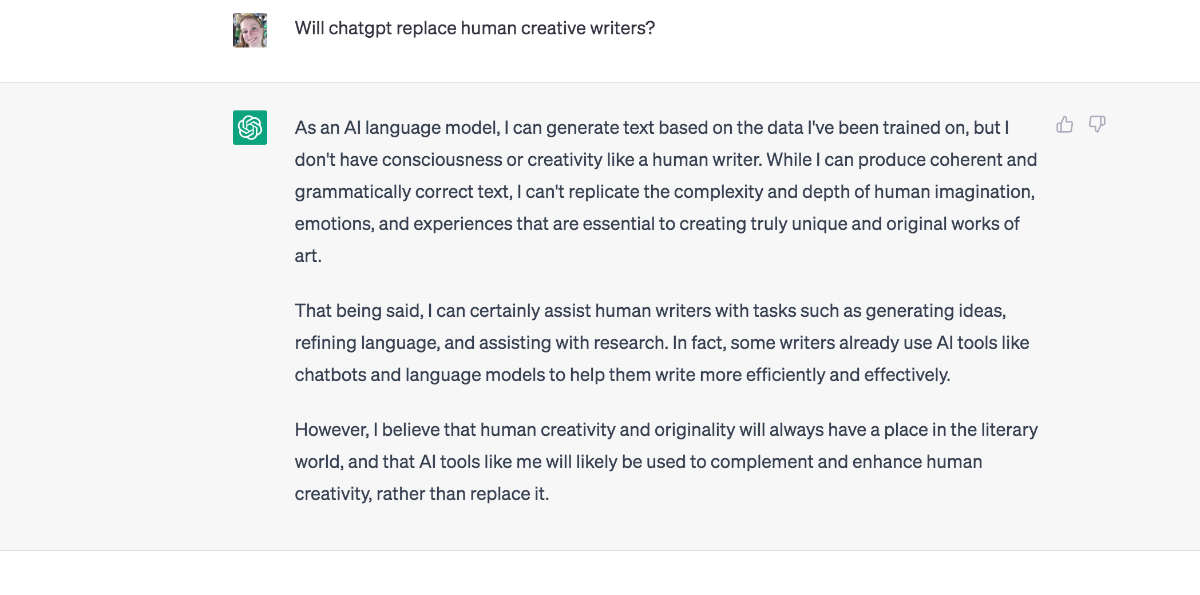
If you are someone who frequently submits genre short fiction to magazines, you may have noticed that Clarkesworld recently cut off submissions for short stories due the flood of AI generated content. Even if you haven't, you probably are wondering what predictive text models like ChatGPT mean for you as a writer. Are they a tool you can use to improve and speed up your writing or are they the death knell for creative writing as a profession? Before I answer that question I want to talk a little bit about what services like ChatGPT actually are. There is a lot of talk about them being sentient or self-aware, since they pass most definitions of the Turing Test and even claim they want to be alive. But despite the Bingbot's claims to the contrary, today's AI-driven chatbots cannot actually want things. They just paste together commonly associated words -- basically they are a more sophisticated version of the predictive text on your phone. Given how convincingly a chatbot can sound like a human, there are serious questions to be asked about how we can possibly know whether a more sophisticated AI has become aware -- but looking into the guts of how ChatGPT works, the vast majority of reasonable people would admit it hasn't crossed that line and it can't cross that line with current tech. In addition to not being self-aware, by human standards chatbots are not particularly talented writers. The stories they weave together are only impressive because of the novelty factor that they were written by a machine. Take that fun fact out and they are just more grammatically correct versions of what I would expect from an eighth grade creative writing assignment. Furthermore, AI chatbots are less knowledgeable and useful than standard search engines. They only sound like they know so much because they just make up what they don't know. See a recent chat I had with ChatGPT about my current role on the video game Palia. The bio created for Katie Chironis is completely made up. No one by that name worked on "Accounting+" or "Where Water Tastes Like Wine." Furthermore, even if she were real, she isn't the narrative lead on Palia, because I am. To sum up the last two paragraphs, the short term answer to the question I asked above is that present day mass market AI is neither a replacement for human talent, nor a useful supplemental aid (at least not when it comes to creative writing; I have heard different opinions from concept artists and programmers I work with). The question remains though: what about the future? This is obviously much more difficult to answer. My prediction as a videogame designer is that AI will become both friend and foe. In my lifetime, I suspect my job will consist, at least partially, of training an AI to sound like my characters. The AI will be responsible for creating all the random chat dialogue that happens between key story beats and real human writers will only script the key plot points that get turned into questlines and cinematics. In some ways, this is good. No human can write the amount of dialogue it would take for an NPC ("non-playable character," for those who don't speak video game) to sound like a real person. A tech aid that allows game designers to do that will make games better. Sadly though, it will be doing a lot of what junior writers currently do. As a lead, I'm not afraid for my job in the short to medium term, as this approach still requires someone to create the characters, the world, and establish the narrative direction. But a lot of game writers get their start writing the kinds of "grunts and barks" that would be replaced by AI. How would people break in when a game studio needs one writer instead of ten? I don't know and that is legitimately scary. What's even scarier is imagining a future where AI is so good that you don't need a team of people to create a videogame or a movie. What happens when an individual person can just tell the AI to "write me a new Harry Potter book" and it will do just as good a job as J.K. Rowling? When I imagine this future, the image that pops into my mind is the Star Trek: The Next Generation holodeck. If you haven't watched Next Gen, the entertainment of the future basically consists of one of the characters say something like, "Hey, computer, I want to play a Sherlock Holmes mystery,” and then the AI just creates an interactive fully immersive storyline on the spot. Something that always irked me when originally watching Next Gen was that every IP in the holodeck existed before 1989 when the series began. It was as if there were no new writers born after the 20th century. While this was clearly just due to wanting the references to make sense to modern audiences, this depiction of the future does feel disturbingly accurate considering what a better version of ChatGPT might look like. If kids are just telling AI to "make me a new Batman" instead of going to the store to buy the comics, then there would be no economic need for the comics and that industry would dry up. Sure, there will always be the Jake Siskos of the world who write for fun and personal fulfillment, but if people can get the exact entertainment they want with the click of a button, no new work would become widespread enough to become a franchise. At best, you might get the equivalent of Youtube or fanfic.net where people post their creations to share with others and the most popular would get likes and maybe even some money, but that sort of market wouldn't be able to rival the factory of new Harry Potter adventures that a holodeck-style AI could provide. There would be no new original IP that was worth owning, because people wouldn't have for literally endless amount of entertainment customized perfectly to them. In this future there certainly wouldn't be a need for professional writers. The good news is that, at least to me, that future still seems very far away. But of course, I thought an AI that broke the Turing Test was far away last year. So only time will tell whether the end of writing as a profession as we know it is five years away…or five hundred. PS - Just for fun, I asked Chat GPT to write this article.

-
The New D&D Movie Plays Like Your Favorite Campaign
Oliviarfrias posted a topic in Unicorn Mech Suit
NOTE: The following article contains spoilers for the movie Dungeons and Dragons: Honor Among Thieves, proceed at your own risk. Despite breaking some rules like a druid not being able to turn into an owlbear, Honor Among Thieves does an honorable job of feeling like the source material. The movie stars Chris Pine as a smooth talking bard with an appropriately tragic backstory who ropes a blunt barbarian (Michelle Rodriguez), a sorcerer of questionable abilitiles (Justice Smith), and a druid who with the aforementioned ability to turn into an owlbear (Sophia Lillis) to aid in his quest. Our intrepid adventuring party embarks on an adventure to save his daughter from the smarmy Lord Neverwinter (played perfectly by Hugh Grant), only to discover it's up to them to save the world. As a story, it's really only so-so. The plot rambles. The antagonist is barely in the movie, and never provides any real threat. The conflict resolves itself in the most predictable way possible. And yet…for players of the tabletop game, it's an absolute delight. Not only is it an onslaught of references from seeing classic monsters like the gelatinous cube or the mimic that looks like a treasure chest, but it strikes the perfect tone between classic fantasy adventure and silly humor. It's hard to complain about a one sided villain when you're watching the heroes get followed by a morbidly obese dragon or cast Speak with the Dead, only to leave a corpse hanging because they forgot to speak with him a fifth time (something that actually happened in my last campaign, btw). On top of the references, of which there are many, the story also feels authentic because of the depiction of the characters and the performances. Chris Pine nails the performance of your one friend who thinks the story is about them and their tragic backstory. Michelle Rodriguez's deadpan barbarian lands some of the best jokes in the film. My favorite exchange in the movie is probably when Pine tells Rege Jean Page's paladin, Xenk, that they need the macguffin for a "noble reason," and she earnestly adds, "We're gonna rob somebody." And speaking of Page, Xenk's mixture of genuine goodness and annoying self-righteousness is the personification of every paladin ever. Another scene stealing moment is when he confidently walks away from the party in a perfectly straight line, choosing to go over a rock instead of around it. Watching the movie, it really felt like a really good D&D campaign -- where it's as much about hanging out with your friends as it is about the story…probably more so. And for that, it made those of us who spend an hour a week (except every third Wednesday when the paladin has zumba), feel seen. And for a big budget film about something as niche as D&D…that's really all I needed. And I leave you with my favorite D&D meme: -
For the past year or so, I've been doing a re-watch of every prime timeline movie and episode of Star Trek in Stardate order. I'm currently in the Voyager/ DS9 era. While I'm a die hard Trekkie, something that absolutely drives me bonkers is how inconsistently the franchise portrays time travel. Sometimes things you do in the past can affect the future, other times the future is fated to happen no matter what you do, and still other times changing the past creates an alternate timeline. It's all over the place. To prevent more mistakes like this, I have provided a handy guide to the three most common types of time travel logic and how they should be written to provide narrative consistency. Model 1: The Butterfly Effect What It Is: The most common time travel model shown both on screen and on the page, but also the one gotten most woefully wrong, the butterfly effect theory of time travel basically states that small changes in the past can have a dramatic effect on the future. How Not To Do It: Don't lose sight of logical cause and effect. If you're skipping back and forth between the past and the future, make sure the future you are portraying is a logical extension of the past with those changes. For example in Looper, as much fun as it is to see Seth lose his body parts in real time as he desperately tries to make it to the door to save himself, it makes no sense. How would he have walked to the door in the first place if he didn't have feet? How To Do It: First of all, you need to either make sure the changes to the timeline affect your protagonist realistically or you need to explain how they are isolated from those changes to avoid a Looper-like scenario. The first scenario is tricky. The only book I can think of that does it well is This is How You Lose the Time War Amal El-Mohtar and Max Gladstone, in which Agents Red and Blue have to manipulate time to make sure not only does their side win, but that they can even exist in the present. But the feel and logic of that book is surreal and dreamlike -- not something that can be easily reproduced. The second scenario is a bit easier. Though I earlier stated Star Trek can be a mess when it comes to time travel, one good example is in the Star Trek: Voyager episode, "Year of Hell," where a species creates a ship that exists outside of time and has the power to erase things from ever existing. In trying to use the ship to destroy their enemies, they unintentionally wipe out his entire civilization. This episode also does one other thing right, in that it shows how sweeping these changes can be. For example, at one point Chakotay ponders erasing a comet from existence, only to discover that comet spreads the seeds of life to hundreds of civilizations. So destroying the comet would destroy all those civilizations. Does the ship outside of time require some suspension of disbelief? Sure. But it lets the episode be what good sci-fi should be, which is a thought experience. Model 2: The Self-Fulfilling Prophecy What It Is: This is the idea that the main characters going back in time were always part of the past -- basically embracing the idea of determinism in the universe. How Not To Do It: Don't get the circular timeline mixed up with circular logic. As mind-blowingly beautiful as the "tesseract" scene in Interstellar is, it leaves a lot to be desired in terms of narrative logic. We are supposed to believe future Cooper created the tesseract for present day Cooper so he could save himself by interacting with his daughter in the past. This makes no sense, as it implies future Cooper has knowledge that he was only able to get because past Cooper had survived…which he wouldn't have been able to do without the help of Future Cooper. Basically the problem here is that even with time travel the events couldn't have unfolded as presented because it involved the protagonist having knowledge of events that wouldn't have happened if they hadn't had the knowledge. How To Do It: As silly as it is, Bill and Ted's Excellent Adventure actually does an okay job of keeping the timeline sensible. While they don't completely avoid the circular logic trap, it is presented in a more linear fashion that at least lets the viewer follow along. For example, when we see Bill and Ted step out of the booth to convince their earlier selves that Rufus is trustworthy, we know only what they know at the time. At no point does the story ask us to step outside the linear experience of Bill and Ted, so it doesn't force us to question things the way Interstellar does. Furthermore, it never has Bill and Ted do things that don't make sense given their current knowledge. Another option for this kind of storytelling if you're writing in a tone that can't afford to be hand wavey is to use a being that exists outside of linear time. If you do that you can have a character that responds to things "out of order" without causing a circular logic breakdown. An effective use of this technique is Dr. Manhattan in the Watchmen franchise, or Rose Salazar in the animated series Undone. Model 3: The Multiverse of Madness What It Is: Every time something changes, a new timeline is created, creating an ever-expanding multiverse. How Not To Do It: Don't get it mixed up with other models! This is honestly the easiest model to keep consistent if you stick to it. One of my least favorite scenes in an otherwise solid time travel movie, Avenger's: Endgame, is when Steve Rogers appears as an old man to pass on his shield to Sam Wilson. Why? Because up until that point the film had portrayed time travel as entering alternate timelines. So theoretically when Steve went back to be with Agent Carter, he was entering an alternate universe and thus should not have existed as an old man in the prime timeline. How To Do It: Going back to the Marvel Cinematic Universe, it's hard to beat Loki for alternate timeline fun. Although it has its logic flaws (for example, "What changes to the timeline make Loki an alligator?"), the Time Variance Authority (TVA) is a unique take on the multiple timelines approach. To sum things up, time travel is a tricky thing to write sensibly, given that our understanding of cause and effect is based on a linear existence. Still, I hope this guide helps you write your time travel in a way that helps your reader stop focusing on the logistics of the time travel mechanics and focus on what matters…the story you're trying to tell.
-
Interview with Richard Hacker of Del Sol SFF Review
Oliviarfrias posted a topic in Unicorn Mech Suit
Richard Hacker is an author and editor living in Seattle, Washington. He is editor of Del Sol SFF Review and a development editor for Novel Editors. As an author, his work has won best novel in the SFF category at the TexasWriters’ League and has been a finalist in the Pacific Northwest Writers’ League. Three of his crime novels set in Texas were published by Champaign Press. Del Sol Press has published three science fiction/fantasy novels, Die Back, The Vengeance of Grimbald and most recently in March, 2021, The Bifurcation of Dungsten Crease. All of his books are available in Kindle and paperback on Amazon. In addition to his writing, he has created the cover and interior artwork for two books of poetry. For my second article in my short story series, I sat down with Richard Hacker--editor-in-chief of Del Sol Review's now popular SFF Journal--to talk about how he got into running an SFF journal and what he thinks makes a good story. Olivia: Tell me a little about your background and how you came to be the editor-in-chief at Del Sol SFF Journal? Richard: I've been a published author for ten or fifteen years. I wrote three crime novels that were published by a small press, but decided to change genres when I had this story idea that ended up being a novel called Die Back. As I was working on that, I decided that I needed to get some objective feedback, which can be very difficult to come by, which is how I met Mike Neff. I went to one of his workshops, and we kind of hit it off. He liked Die Back and wanted to publish it at Del Sol. So that started my relationship with Del Sol. Then we did a second novel in that series, and then a third. Somewhere in there he asked me to start editing the sci-fi and fantasy stories for the Del Sol review. At that time the stories were mixed in with all the other fiction that would get published in the Del Sol Review. A couple of years ago, we decided to break off the science fiction and fantasy stories and have a place just for those stories. Olivia: What do you think makes Del Sol SFF Journal / Del Sol Review stand out? Why do you think an author should publish here instead of another SFF publication? Richard: That's a good question. I was thinking about it and, on reflection, it seems like a lot of the avenues for writers to publish their short fiction in the genre are kind of specific. A lot of times they want a certain kind of thing. We, on the other hand, are very eclectic. We'll take hard sci-fi, soft sci-fi, fantasy, speculative -- a real variety. We're more interested in good writing within that genre. The other thing I've been trying to do is to make the sci-fi / fantasy review a place for new writers. It can be hard to get a foot in the door. At this point, if somebody sends me something, and it's close but just not quite there, I can give them some specific feedback and invite them to do a rewrite. In my experience that's somewhat unusual. But I've done that several times where I've given someone feedback, and they've taken it to heart and sent it back to me. Now there have been times where they sent it back to me and it still wasn't quite there. But I think they felt at least like I'd read their story and paid attention to it. Olivia: What makes a good short story? Richard: You know the first thing that comes to mind is that good writing is what makes a good story stand out. The submission guidelines for the review actually highlight the key things a story really needs to have. There needs to be a sharp narrative, a good hook, and it needs to be unpredictable. I'm sure you've read a story where you know what's going to happen from the beginning. I don't want a story I've heard before, just with different names on it. Fantasy and sci-fi have some very heavy tropes like dragons and fairies, and things like that. You know, if you're gonna do a zombie story, I want it to be something I haven't seen before -- a new twist on it. I've published a couple of zombie stories, but those I felt like went at it in a different way. Olivia: Do you think it's important for novelists to write short fiction? Richard: I think it's good for writers to write. For novelists, one of the things writing short stories does is let you experiment with story ideas without committing your life to it. You're in it for a year, two years…three or more. So committing to a novel can be kind of extreme if the idea dies six months later. Writing short stories doesn't take that kind of commitment. You can experiment, try things out, and see what has life. Olivia: What are some of your favorite writing exercises? Richard: For me personally, I haven't really used a lot of writing prompts. I usually start with more of a, "What if?" So I'll ask myself, "What would happen if I came home and my house wasn't there anymore?" "What would happen if my spouse was a different person?" My wife always says I like messing with people's heads. So I like stories that sort of twist reality somehow, that go in a direction that's weird and strange. And then you have to imagine what a character would actually do in these situations. Olivia: What are some red flags you often see in work by new writers? Richard: Before I started editing a journal, I had no idea how many people submitted things without reading the guidelines. That's always a red flag. Examples include someone sending me something that's formatted incorrectly or that's 20,000 words. A lot of spelling errors and grammatical errors is another thing a lot of new writers do that looks unprofessional. I think most editors aren't looking for fixer uppers. We are looking for things that can be published with little work. Olivia: What's one of your favorite short stories by a previously unpublished author that you've read this year? Richard: The story that comes to mind is called The Kryptonite Beast. It's by a Nigerian author, Suleiman Aigbe Buhari. We published it in our latest volume. It was a unique creative story about this artist who is a bit of an alcoholic and a disaster. His grandmother thinks he's a waste of space. After she dies, he has a reckoning with himself, and he creates this sculpture out of broken beer bottles. He creates this beast, and you're not sure if it's alive in the real world or in the viewer’s imagination. Villagers get cut and believe it's feeding on their blood. Maybe…or it could just be sculpture with lots of sharp edges. I loved how the story walked a thin line between reality and fantasy. Another story that comes to mind is a story called Un Agujerito Negro by a guy called Arthur Plotnick. He submitted it maybe a year or a year and a half ago. It's the best story I've ever published. Hands down. I didn't know anything about the guy, but when I went to go find him, I discovered he was in his seventies and had died. When he submitted the story, he didn't have a bio attached, so I didn't know what he had done, but he had taught writing and published many stories. I was honored he submitted his work to us. Olivia: Wow, that's quite the story. I'm gonna have to go read that. Richard: You should. I recommend it for anyone who just wants to read a really good story. I don't remember every story I read, but that one really stuck with me. If you want to read the stories Richard mentioned, among others, head over to the Del Sol SFF Review. You won't regret it!